
You stand in the center of a bustling outdoor plaza, surrounded by bright red “70% OFF” signs and the familiar logos of luxury brands. The air feels charged with the thrill of the hunt. You just found a designer jacket for $89 that originally cost $250—or at least, that is what the tag says. This experience defines the modern outlet mall, a staple of American consumer culture that promises high-end style on a middle-class budget. However, the reality behind those polished storefronts has changed dramatically over the last two decades. While outlet shopping once meant digging through literal “factory seconds” or last season’s leftovers, it now represents a sophisticated, multi-billion dollar manufacturing industry designed specifically for the bargain-seeker.
Learning to manage your impulses with a Prime Day strategy or similar plan for major retail events can help prevent these specialized environments from draining your budget.
This is why it is vital to budget for holiday spending before the temptation of mall signage takes over.
This educational guide provides general information for U.S. residents learning about consumer spending and smart shopping strategies. The strategies and concepts discussed here are for educational purposes and may not apply to your specific situation. Everyone’s financial circumstances are unique—factors like income, debt levels, family situation, tax bracket, and financial goals all affect which approaches might work best. For personalized advice tailored to your situation, we recommend consulting with a qualified financial professional such as a Certified Financial Planner (CFP) or CPA.

Key Takeaways
- The 80% Rule: Up to 80% of items in many modern outlet stores are manufactured specifically for the outlet and never sat on a retail shelf.
- Quality Markers: Lower-tier materials, simplified hardware, and thinner linings often distinguish “made-for-outlet” goods from flagship retail products.
- The M.S.R.P. Myth: The “Manufacturer’s Suggested Retail Price” on an outlet tag often represents a price the item was never intended to sell for at a traditional store.
- Total Cost of Attendance: Savvy shoppers must factor in gas, travel time, and the “sunk cost” psychological pressure to buy when evaluating a deal.
- Tag Deciphering: Learn to spot specific icons, like three dots or a diamond, which many brands use to identify outlet-only merchandise.

The Evolution of Outlet Malls: From Factories to Front Porches
To understand if you are getting a deal, you must first understand what an outlet mall actually is. In the 1970s and 80s, factory outlets lived up to their name. They were typically located next to the actual factory where the clothes were made. Brands used these stores to sell “seconds”—items with minor defects like a crooked seam or a missing button—and “closeouts” from last season that didn’t sell in department stores. If you shopped at an outlet in 1985, you likely bought the exact same quality as the flagship store, just with a small flaw or a dated style.
Comparing outlet prices to year-end events like Black Friday vs. Cyber Monday is essential to determine if you are truly getting a unique bargain.
Today, the landscape is entirely different. According to the Federal Trade Commission (FTC), many companies now sell products in outlet stores that are manufactured specifically for those stores. These items use lower-quality materials to keep prices down while maintaining the brand’s aesthetic. The shift happened because the demand for “brand-name bargains” outpaced the supply of defective or unsold goods. To meet this demand, brands created “factory lines.”
“Beware of little expenses; a small leak will sink a great ship.” — Benjamin Franklin, Historical Polymath and Author
As Franklin noted, small, habitual shopping trips that feel like “savings” can actually drain your wealth over time. When you walk into a modern outlet mall, you are rarely looking at a clearance center. You are looking at a specialized retail environment designed to maximize the volume of sales by appealing to your desire for a high-status logo at a low-status price point.

The “Made-for-Outlet” Secret: A Different Production Line
The biggest secret in the industry is that the shirt in the outlet store and the shirt in the downtown boutique might share a logo, but they rarely share a DNA. Most major brands—including Coach, J.Crew, Gap, and Nike—operate two distinct supply chains. One supply chain focuses on high-quality materials and craftsmanship for retail stores, while the other focuses on cost-efficiency for outlet stores.
If quality is your primary concern, buying refurbished flagship products often provides a better value-to-durability ratio than purchasing a lower-tier outlet line.
For example, a “retail” leather bag might use top-grain leather that develops a patina over time. The “outlet” version of that same bag might use “bonded leather” or a thinner hide coated in plastic to mimic the look of the higher-end version. The Consumer Financial Protection Bureau (CFPB) emphasizes the importance of understanding what you are buying before you commit your hard-earned dollars. If you buy a product thinking it is a discounted $400 item, but it was actually designed to be a $100 item from the start, you haven’t saved $300. You simply paid the market price for a lower-tier product.
Research indicates that for some major apparel brands, as much as 80% to 90% of the merchandise found in their outlet locations was never intended for a traditional retail store. This doesn’t mean the clothes are “bad,” but it does mean the value proposition is different than what the marketing suggests.

How to Spot a Dud: 5 Quality Tests Every Shopper Needs
To tell if you are getting a deal or a dud, you need to look past the logo and examine the construction. Use these five tests to evaluate any piece of clothing or accessory before heading to the register:
Consulting a list of things you should never buy new can further refine your shopping habits by identifying where the best pre-owned deals hide.
- The Light Test: Hold a garment up to the light. In made-for-outlet items, the weave is often looser and the fabric thinner. If you can see the distinct outline of your hand through a pair of “heavy duty” chinos, they won’t last more than a few dozen washes.
- The Hardware Check: Feel the zippers and buttons. Retail items typically use heavy brass or high-quality metal zippers (like YKK). Outlet versions often use plastic zippers painted to look like metal or lighter-weight alloys that are prone to snagging or breaking.
- The Seam Stress Test: Gently pull at the seams. Look for “stitch density”—the number of stitches per inch. High-quality retail garments have more stitches per inch, making the seam stronger. Outlet versions often use longer, looser stitches to save on thread and production time.
- The Lining Inspection: Check the inside. High-quality coats and blazers are usually fully lined with silky fabrics like rayon or acetate. Outlet versions may be unlined or use “half-linings” with exposed, roughly finished seams.
- The Button Secret: Look for “spare” buttons. Most retail brands include a small bag of extra buttons or sew them into the care tag. Many outlet-specific lines skip this small expense to save pennies per unit.

Deciphering the Tags: M.S.R.P. and Pricing Psychology
The price tag is the most powerful tool a retailer has to influence your brain. Most outlet tags feature two prices: the “M.S.R.P.” (Manufacturer’s Suggested Retail Price) and the “Our Price.” This creates a psychological effect known as anchoring. Your brain “anchors” to the higher number and perceives the lower number as a massive win, regardless of the item’s actual value.
To verify if an outlet price is genuine, utilizing price tracking tools on your mobile device can reveal the item’s true market history.
However, many outlet items have tags that are printed with a “Value” or “M.S.R.P.” that the item never actually sold for in any store. Some states have even seen class-action lawsuits over this practice, arguing that comparing an outlet price to a “fake” retail price is deceptive. The FTC monitors deceptive pricing, but the burden of awareness often falls on you, the consumer.
Look for these brand-specific “tell-tale” signs on tags to identify outlet-only goods:
- Gap and Banana Republic: Look for three small squares or dots embossed on the tag below the brand name. This indicates it is a factory-exclusive item.
- J.Crew: Look for two small diamonds on the tag.
- Coach: Look for a “creed patch” inside the bag. If the serial number starts with an “F,” it stands for “Factory,” meaning it was made for the outlet.
- Brooks Brothers: Look for “346” on the label, which refers to their outlet line (named after their famous 346 Madison Avenue address, but representing a lower-tier production).

Comparison Table: Flagship Retail vs. Factory Outlet
Use the following table to understand the typical differences you will encounter when comparing these two shopping environments.
Regardless of where you shop, mastering how to stack coupons, sales, and cashback remains the most effective way to lower your final total at the register.
| Feature | Flagship Retail Store | Factory Outlet Store |
|---|---|---|
| Source of Goods | Current season, high-tier production. | Made-for-outlet (80%) or Overstock (20%). |
| Fabric Quality | Natural fibers (wool, silk, 100% cotton). | Blends (poly-blends, synthetic stretching agents). |
| Construction | Detailed stitching, finished seams, full linings. | Simplified construction, fewer stitches per inch. |
| Hardware | Heavy metal zippers, real horn or mother-of-pearl buttons. | Lightweight alloys, plastic buttons, thinner zippers. |
| Return Policy | Usually flexible, can return at any location. | Often “Final Sale” or outlet-only returns. |
| Sizing | Consistent with brand standards. | Can vary widely; “vanity sizing” is more common. |

The Math of the Trip: Calculating Your True Savings
A “deal” isn’t a deal if you spend more to get it than you save on the product. Outlet malls are notoriously located 30 to 60 miles away from major metropolitan areas. This is a deliberate strategy. First, it prevents “brand dilution”—the high-end store doesn’t want its full-price customers seeing the same logo on a discount rack nearby. Second, it leverages the sunk cost fallacy. Once you have driven an hour, you feel a psychological need to buy something to “justify” the trip.
To calculate your true savings, use this formula:
Actual Savings = (Retail Price – Outlet Price) – (Travel Costs + Opportunity Cost)
Consider a trip where you save $100 on clothing. If you drove 80 miles round-trip in a vehicle that costs $0.67 per mile to operate (the 2024 IRS standard mileage rate), your travel cost is $53.60. If the trip took four hours of your time, and you value your time at $25 per hour, your opportunity cost is $100. In this scenario, you haven’t saved $100—you have actually “lost” $53.60 in total value. While shopping can be a form of entertainment, viewing it strictly as a financial saving mechanism requires a more rigorous look at the data.

The Psychological Traps of the Outlet Experience
The outlet mall is a masterclass in behavioral economics. Retailers use several “nudges” to get you to open your wallet:
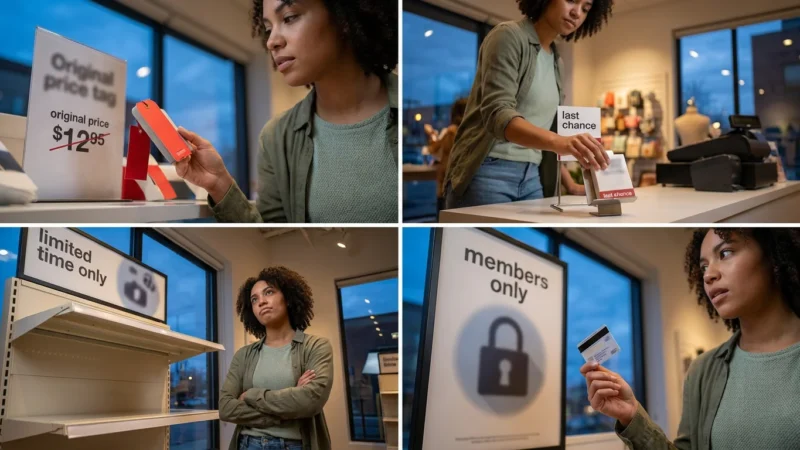
- Scarcity and FOMO: “When it’s gone, it’s gone.” Because outlet inventory changes quickly, you feel pressure to buy immediately.
- The “Treasure Hunt” Effect: Finding a genuine retail overstock item among the made-for-outlet racks triggers a dopamine hit in the brain. This keeps you searching longer and increases the likelihood of “impulse filler” purchases.
- The Clearance Circular Logic: Stores often place “70% OFF” signs at the front, but the fine print says “Up to 70%.” Most items are actually 30-40% off, but your brain remains anchored to the 70% figure.
- Bundle Pricing: “Buy 3 for $30” deals encourage you to buy more than you need. According to data from the Federal Reserve’s 2023 Survey of Consumer Finances, discretionary spending—which includes clothing and accessories—is one of the first areas where Americans overextend themselves when they perceive a “sale.”
“Spend extravagantly on the things you love, and cut costs mercilessly on the things you don’t.” — Ramit Sethi, Author of “I Will Teach You To Be Rich”
Sethi’s advice is crucial here. If you love a specific designer’s aesthetic, buying their outlet line might be a conscious, joyful choice. However, if you are buying it just because it is “on sale,” you are failing to cut costs on the things that don’t actually matter to you.

Expert Outlet Shopping Hacks for Maximum Value
If you decide that outlet shopping fits into your financial plan, use these tactics to ensure you are getting the absolute best value for your money:
- Shop the “Back Left”: In most retail layouts, the deepest discounts and actual clearance items (the “true” overstock) are located in the back left corner of the store. The items at the front are almost always full-price, made-for-outlet “new arrivals.”
- Join the VIP Club: Almost every outlet center (like Simon or Tanger) has a free digital VIP club. These apps often provide “stackable” coupons that take an extra 20% off the already discounted price.
- Verify the Return Policy: Many outlet stores have a “No Returns” policy or require you to return items to an outlet location, not a regular retail store. Always ask before you swipe.
- Visit on Tuesday or Wednesday: Outlets get their new shipments of actual retail overstock early in the week. By Saturday, the “good stuff” is gone, and you are left with the picked-over made-for-outlet inventory.
- Use the “24-Hour Rule”: If you find something you love, ask the clerk to hold it for an hour while you walk the rest of the mall. If you still want it after the dopamine hit of the “find” has faded, it might be a worthy purchase.

Integrating Shopping into Your Overall Financial Plan
Shopping should never happen in a vacuum. To maintain financial health, your outlet trips should fit within a structured budget. A popular framework is the 50/30/20 rule, popularized by Senator Elizabeth Warren. In this model, 50% of your income goes to Needs, 30% to Wants (including outlet shopping), and 20% to Savings and Debt Repayment.
Before you head to the outlet mall, decide on a “walk-away number.” This is the maximum amount of money you are willing to spend today. By setting this limit before you enter the high-pressure sales environment, you retain control over your finances. According to the Bureau of Labor Statistics Consumer Expenditure Survey, the average American household spends about $1,500 to $2,000 annually on apparel and services. If one outlet trip consumes half of that budget, you may find yourself struggling to cover essential clothing needs later in the year.

When to Consult a Financial Professional
While learning to shop smarter is a valuable skill, some financial situations require more than just “hacks.” You should consider consulting a professional in the following scenarios:
- Chronic Overspending: If you find that “bargain hunting” is leading to credit card debt that you cannot pay off monthly.
- Budget Misalignment: If you are unsure how to balance your desire for lifestyle spending with long-term goals like retirement or homeownership.
- Debt Management: If your shopping habits have contributed to a debt-to-income ratio that feels unmanageable.
- Tax Planning: If you are a business owner or “side hustler” and need to know which purchases might be deductible.
To find qualified help, visit the CFP Board to find a Certified Financial Planner or the National Foundation for Credit Counseling (NFCC) for help with debt management. DIY strategies have limits, especially when emotional spending patterns are involved.
Frequently Asked Questions
Is it possible to find real retail items at an outlet?
Yes, but it requires patience. Look for “one-off” items that don’t have a full range of sizes nearby. These are often returns or overstock from flagship stores. Check the labels for the “outlet-specific” markers mentioned earlier; if those markers are missing, you likely have a retail-quality item.
Are outlet malls actually cheaper than online sales?
Often, no. Major brands frequently run “End of Season” sales on their primary websites that offer 40-60% off high-quality retail items. When you factor in the cost of driving to an outlet, an online sale on a higher-quality product is often the better financial move.
Why do brands make lower-quality items for outlets?
It is a matter of profit margins. By using cheaper materials and simpler designs, brands can sell items at a lower price point while still making a significant profit. It allows them to reach “aspirational” customers who want the brand name but cannot or will not pay flagship prices.
What are the biggest risks of outlet shopping?
The primary risks are the “sunk cost” drive to spend money you hadn’t planned to spend and the potential for buying low-quality goods that will need to be replaced much sooner than high-quality equivalents. This “false economy” can lead to spending more over time.
How do I know if an outlet sale is “fake”?
If the “sale” price is the same every time you visit the store (e.g., “Always 50% Off”), then that is the actual price of the item. A real sale is a temporary reduction from a price that is actually charged for a significant period.
When should I consult a professional about my shopping habits?
Consult a professional if your shopping feels compulsive, if you are hiding purchases from a partner, or if you are using high-interest credit cards to fund “deals” that you cannot afford to pay off in full each month.
What are the limitations of this guide?
This guide provides general education on retail trends and quality markers. It cannot account for your specific budget, your local outlet mall’s specific inventory, or changes in brand manufacturing policies that happen after publication. Always do your own research on specific products.
Last updated: January 2026. Information accurate as of publication date. Financial regulations, rates, and programs change frequently—verify current details with official sources.
This article was reviewed for accuracy by our editorial team.
For trusted financial guidance, visit
The Balance,
Kiplinger and
Forbes Advisor.
Educational Content Notice: This article provides general financial education and information only. It is not personalized financial, tax, investment, or legal advice. Your financial situation is unique—what works for others may not work for you. Before making significant financial decisions, consider consulting with a qualified professional such as a Certified Financial Planner (CFP), CPA, or licensed financial advisor.
Important: EasyMoneyPlace.com provides educational content only. We are not licensed financial advisors, tax professionals, or registered investment advisers. This content does not constitute personalized financial, tax, or legal advice. Laws, tax codes, interest rates, and financial regulations change frequently—always verify current information with official government sources like the IRS, CFPB, or SEC.
No Guaranteed Results: Financial outcomes depend on individual circumstances, market conditions, and factors beyond anyone’s control. Past performance, general strategies, and examples discussed in this article do not guarantee future results. Any financial projections or examples are for illustrative purposes only.
Get Professional Help: For personalized financial advice, consult a Certified Financial Planner (CFP). For tax questions, consult a CPA or enrolled agent. For those experiencing financial hardship, free counseling is available through the National Foundation for Credit Counseling.








Leave a Reply