
You know the feeling. You walk into a store intending to buy a single tube of toothpaste, or you log onto a website to check the price of a specific replacement part. Twenty minutes later, your cart is full. You have capitalized on a “Buy One, Get One” deal, snagged a shirt that was 40% off, and added a few impulse items to hit the free shipping threshold.
You didn’t plan to spend that money. Yet, you walk away feeling like you won. You “saved” money.
This isn’t a failure of willpower. It is the result of a sophisticated, multi-billion-dollar machine designed to influence your behavior. Retailers, marketers, and advertisers leverage decades of behavioral psychology research to bypass your logical decision-making and tap directly into your emotions. They know exactly which buttons to push to convert a browser into a buyer.
Understanding these psychological triggers is the first step toward reclaiming control of your wallet. When you can spot the game, you can choose whether or not to play.
Audience Scope: This guide is for U.S. residents looking to understand their spending habits and improve their financial health. It covers general behavioral finance concepts applicable to everyday consumers. If you have complex financial circumstances, compulsive buying behaviors, or significant debt issues, we recommend consulting with a qualified financial professional or a certified credit counselor.

Key Takeaways
- It’s biology, not just bad habits: Sales trigger dopamine releases in the brain similar to other pleasure-seeking behaviors, making the urge to buy physically difficult to resist.
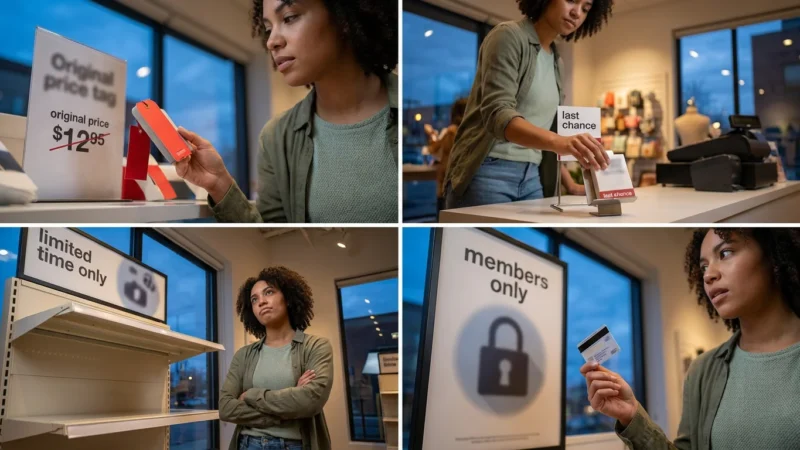
- The price is often an illusion: Retailers use “anchoring”—displaying a high original price—to make the selling price look like a bargain, regardless of the item’s actual value.
- Scarcity creates artificial urgency: Phrases like “Limited Time Only” or “Only 3 Left” shut down logical thinking and force panic-buying.
- Friction is your friend: Adding steps between the impulse and the purchase (like removing saved credit cards) creates the necessary space for your logical brain to catch up.
- Awareness breaks the spell: Simply naming the sales tactic (e.g., “That is the decoy effect”) can reduce its power over you.

The Retail Battlefield: It’s Not a Fair Fight
Many consumers view shopping as a neutral activity. You need something, you find it, you buy it. However, the environment in which you shop—whether physical or digital—is engineered to dismantle that neutrality. From the lighting in the aisles to the color of the “Add to Cart” button, every detail is tested and optimized to encourage spending.
To truly beat retailers at their own game, you can learn how to stack coupons and cashback to lower the final price significantly.
Beyond awareness, learning how to shop clearance like a pro can help you determine if a markdown is a legitimate value.
While retailers have their strategies, you can learn how to negotiate prices to ensure you are getting the absolute best deal on your terms.
In physical stores, essentials are often placed at the back, forcing you to walk past high-margin impulse buys. In online stores, algorithms analyze your browsing history to present products you are statistically most likely to want, right when you are most likely to buy them.
According to the Federal Trade Commission (FTC), truth-in-advertising laws exist to prevent outright deception, but the line between persuasive marketing and psychological manipulation is often blurry. Retailers operate in the gray areas of human psychology, using perfectly legal tactics that exploit how our brains process value and risk.

Your Brain on Bargains: The Dopamine Loop
To understand why we overspend, we have to look at the brain’s reward system. When you see an item you want on sale, your brain anticipates a reward. This anticipation releases dopamine, a neurotransmitter associated with pleasure and motivation.
Interestingly, the “high” often comes from the act of purchasing or the thrill of the hunt, rather than the ownership of the item itself. This is why “buyer’s remorse” is so common. Once the transaction is complete, the anticipation fades, the dopamine levels drop, and you are left with less money and an item you may not actually need.
Research highlighted by Investopedia in the field of behavioral finance suggests that the pain of paying (the negative feeling of parting with money) is significantly reduced when we use credit cards or digital payments compared to cash. When you combine the dopamine hit of a “deal” with the frictionless, painless nature of digital payment, overspending becomes the path of least resistance.

5 Psychological Triggers Retailers Use Against You
Awareness is your best defense. Once you can identify these tactics in the wild, their influence over your wallet weakens. Here are the most common psychological levers retailers pull.
1. Anchoring
Anchoring is the cognitive bias where we rely too heavily on the first piece of information offered (the “anchor”). In retail, the anchor is the “Original Price” or MSRP.
Example: You see a jacket with a price tag of $200 crossed out, now marked $100. Your brain anchors to the $200 value. You feel like you are gaining $100 of value for free. If the jacket had simply been priced at $100 with no reference to a higher price, you might have looked at it and thought, “That’s expensive for a jacket.” The anchor changes your perception of value.
2. Scarcity
Scarcity triggers our primal fear of missing out (FOMO). When resources are limited, they seem more valuable.
Example: “Only 2 left in stock!” or “Sale ends in 3 hours!” When you believe an opportunity is vanishing, your brain shifts from a logical assessment (“Do I need this?”) to a competitive, panic-based assessment (“I must get this before someone else does”).
3. The Decoy Effect
This tactic is used to push you toward a more expensive option by introducing a third, less attractive option.
Example:
Option A: Small Popcorn – $4.00
Option B: Medium Popcorn – $7.50
Option C: Large Popcorn – $8.00
The Medium popcorn is the decoy. It exists solely to make the Large look like an incredible deal. You spend $8.00 instead of $4.00 because you believe you are “beating the system” by getting the giant size for only 50 cents more than the medium.
4. Loss Aversion
Psychologically, the pain of losing something is about twice as powerful as the pleasure of gaining something. Retailers use this by framing purchases as avoiding a loss.
Example: Free trial periods or “Try before you buy” programs. Once the item is in your home, returning it feels like a loss. You are far more likely to keep (and pay for) the item to avoid the feeling of losing it.
5. Social Proof
We look to others to determine correct behavior. In sales, this manifests as “Best Seller” badges, “1,000+ people viewed this today,” or curated reviews.
Example: You are unsure about a blender. You see it has 5,000 five-star reviews. You assume 5,000 people can’t be wrong, suppressing your own doubts about the price or necessity.

The Digital Trap: How Online Shopping Accelerates Spending
E-commerce removes the physical friction of shopping. You don’t have to drive, park, walk, or carry items. The easier it is to buy, the more you will spend. According to the Consumer Financial Protection Bureau (CFPB), the rise of “Buy Now, Pay Later” (BNPL) services has added another layer of risk, allowing consumers to purchase items they cannot immediately afford by splitting payments, often without clear understanding of the terms.
To avoid falling for artificial urgency, you can use price tracking tools to verify if a current price is truly a historic low.
Common Digital Traps:
- One-Click Ordering: Removes the “checkout time” where you might reconsider.
- Gamification: Progress bars showing how close you are to “Free Shipping” encourage you to add items you don’t need just to save $5 on shipping.
- Retargeting Ads: You look at a pair of shoes once, and they follow you around the internet for weeks, wearing down your resistance.

The Emotional Component: HALT and Retail Therapy
Sometimes the trigger isn’t external (a sale sign) but internal. “Retail therapy” is a very real coping mechanism. Spending gives us a sense of control when life feels chaotic, or a boost of excitement when life feels dull.
Addressing the root causes of financial stress and learning how to break the paycheck-to-paycheck cycle can significantly reduce the urge for retail therapy.
To combat emotional spending, use the acronym HALT. Before you make a purchase, ask yourself if you are:
- Hungry
- Angry
- Lonely
- Tired
If you identify with any of these states, address that physical or emotional need directly. Eat a snack, call a friend, take a nap, or go for a walk. Do not try to solve an emotional problem with a financial transaction.
“We buy things we don’t need with money we don’t have to impress people we don’t like.” — Dave Ramsey

Actionable Defense Strategies to Stop Overspending
Now that you understand the psychology, you can implement systems to protect your money. These strategies add friction to the buying process, giving your logical brain time to intervene.
Mastering these defenses allows you to save money while still enjoying life, ensuring your spending aligns with your values rather than a retailer’s marketing goals.
1. The 24-Hour Rule (or 72-Hour Rule)
For any non-essential purchase over a certain amount (e.g., $50), institute a mandatory waiting period. Leave the item in the cart or on the shelf. If you still genuinely want and need it after the waiting period, and you have the cash, you can consider buying it. Most of the time, the urge will vanish.
2. Calculate the “Life Cost”
Translate the price of the item into hours of your life. If you earn $20 an hour after taxes, a $100 pair of shoes costs you 5 hours of work. Ask yourself: “Is this item worth sitting at my desk for 5 hours?”
3. Use Cash or Debit
Credit cards disconnect the pleasure of buying from the pain of paying. Using cash (or a debit card where you see the balance drop immediately) reactivates that pain, making you more mindful of the cost.
4. Unsubscribe and Unfollow
You cannot buy what you do not see. Unsubscribe from retailer email lists. Unfollow influencers who constantly push products. This removes the external triggers from your daily environment.
5. Shop with a List
Never enter a store or a shopping site without a specific list. If an item is not on the list, you are not allowed to buy it during that trip. If you see something you want, write it down for next time. This separates the impulse from the action.
The Real Math of “Savings”
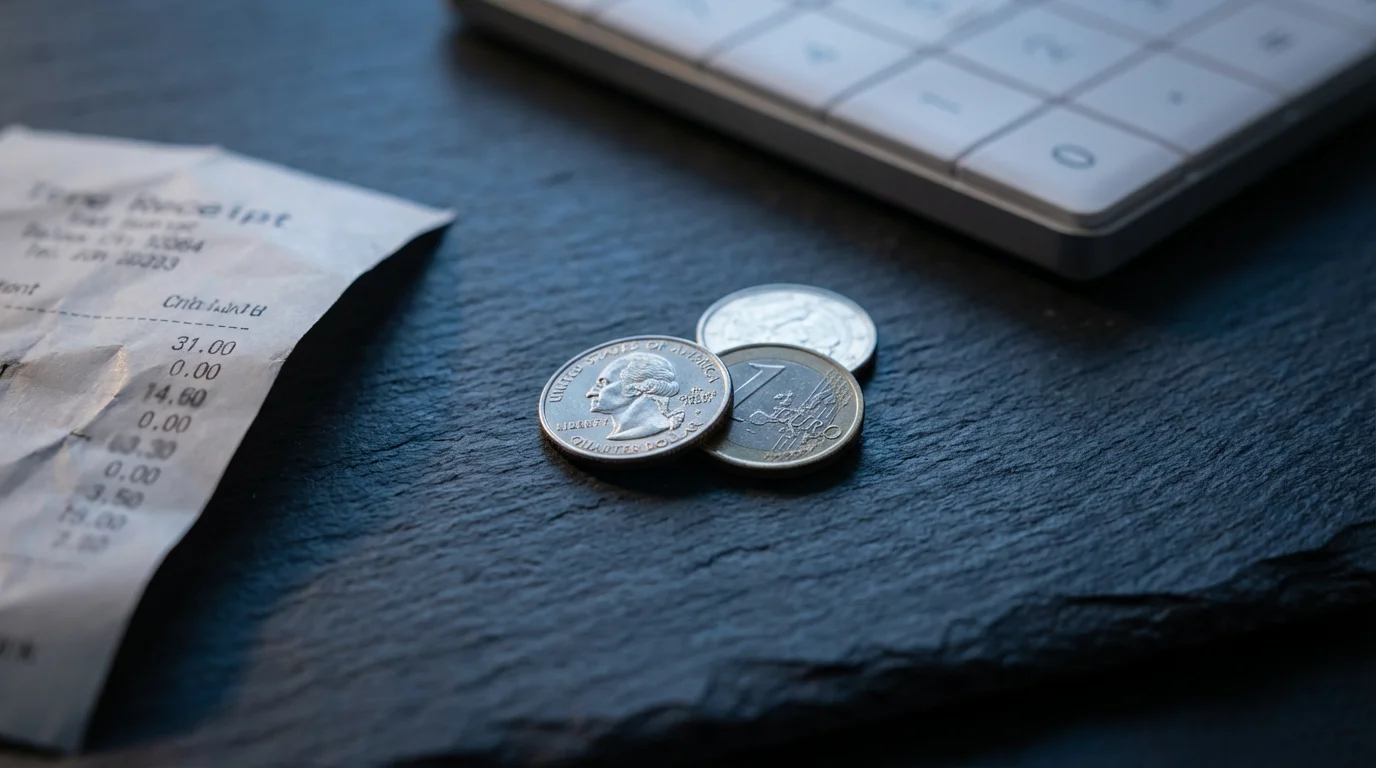
We often justify purchases by focusing on the discount rather than the expenditure. We tell ourselves, “I saved $50,” when the reality is, “I spent $150.”
The following table illustrates the difference between “Sale Math” (what the retailer wants you to think) and “Real Math” (what happens to your bank account).
| Scenario | The Deal | Sale Math (The Illusion) | Real Math (The Reality) |
|---|---|---|---|
| Buying a Sale Item | Jacket: Was $200, Now $150 | “I saved $50!” | You spent $150. |
| Free Shipping Threshold | Cart at $35. Free shipping at $50. | “I need to add $15 to save $8 on shipping.” | You spent $15 extra to save $8. Net loss: $7. |
| Buy One Get One (BOGO) | Shirt $40. BOGO 50% Off. | “I got two shirts for a great price!” | You spent $60. Did you need two shirts? Or just one for $40? |

When to Consult a Financial Professional
While occasional overspending is common, for some, shopping can become a compulsive behavior that threatens their financial stability and well-being. If you find yourself unable to stop spending despite negative consequences, DIY strategies may not be enough.
You should consider consulting a professional if:
- You hide purchases or lie about spending to family members.
- You feel intense anxiety or depression that is only temporarily relieved by shopping.
- Your spending has led to unmanageable debt, missed bill payments, or legal issues.
- You use shopping as your primary coping mechanism for stress or trauma.
Who can help?
- Certified Credit Counselors: Organizations like the National Foundation for Credit Counseling (NFCC) offer free or low-cost budget counseling and debt management plans.
- Therapists: Licensed mental health professionals can help address the underlying psychological drivers of compulsive buying disorder.
- Financial Planners: A Certified Financial Planner (CFP) can help you structure a plan to recover from debt and build wealth, provided the behavioral issues are also being addressed.
According to the Securities and Exchange Commission (SEC), checking the background of any financial professional is crucial before engaging their services. You can use official government tools to verify credentials.
Frequently Asked Questions
Is it ever okay to buy things on sale?
Absolutely. Buying items on sale is a smart financial move if the item was already on your list and you have the money to pay for it. The problem arises when the sale itself creates the desire for an item you didn’t previously need. Strategic shopping is smart; impulse shopping is costly.
How do I know if a “sale” price is actually a good deal?
Do not trust the “original price” listed by the retailer. Use price-comparison tools or browser extensions to see the price history of the item. Often, you will find the item sells for the “sale” price the majority of the time, meaning the discount is fake.
Why do I feel guilty after shopping?
This is often called “buyer’s remorse.” It occurs when the dopamine rush of the purchase wears off, and your logical brain realizes that the purchase conflicts with your long-term goals (like saving for a house or paying off debt). This guilt is a signal that your spending is not aligned with your values.
What are the risks of using “Buy Now, Pay Later” services?
While convenient, these services can encourage you to spend more than you can afford by making the purchase feel smaller. As noted by the Consumer Financial Protection Bureau (CFPB), missing payments can result in late fees and damage to your credit score, and returning items bought through these services can sometimes be complicated.
Can budgeting apps help stop overspending?
Yes. Budgeting apps give you a clear view of your financial reality. When you have to manually enter a transaction or see a category turn red, it forces you to confront the math. We recommend apps that connect to your bank account for real-time tracking.
When should I consult a professional about my spending?
If your spending is causing relationship problems, significant debt, or emotional distress, or if you feel unable to stop despite wanting to, you should seek help. This could be a sign of Compulsive Buying Disorder, and professional therapy or credit counseling is often necessary.
How does “spending to save” hurt my finances?
Spending money to earn credit card points, airline miles, or “save” on discounts is a losing game if you are paying interest. If you carry a balance on a credit card with 20% interest, no 15% off sale or 2% cash back reward will ever put you ahead mathematically.
Last updated: January 2026. Information accurate as of publication date. Financial regulations, rates, and programs change frequently—verify current details with official sources.
This article was reviewed for accuracy by our editorial team.
For trusted financial guidance, visit
Securities and Exchange Commission (SEC),
USA.gov Benefits,
National Credit Union Administration (NCUA),
AARP Money and
National Foundation for Credit Counseling (NFCC).
Important: EasyMoneyPlace.com provides educational content only. We are not licensed financial advisors, tax professionals, or registered investment advisers. This content does not constitute personalized financial, tax, or legal advice. Laws and regulations change frequently—verify current information with official sources.
Disclaimer: This article is for informational purposes only and does not constitute financial, tax, or legal advice. Individual financial situations vary, and we encourage readers to consult with qualified professionals for personalized guidance. For those experiencing financial hardship, free counseling is available through the National Foundation for Credit Counseling.







Leave a Reply