
You probably remember the old-fashioned glass jar on the kitchen counter—the one where you tossed your loose nickels, dimes, and quarters at the end of every day. For decades, this was the simplest way to save without feeling the “pinch.” In the digital age, that jar has transformed into sophisticated software. Micro-saving apps now automate this process, scanning your digital transactions and siphoning off small amounts of money into savings or investment accounts.
This educational guide provides general information for U.S. residents learning about micro-saving apps. The strategies and concepts discussed here are for educational purposes and may not apply to your specific situation. Everyone’s financial circumstances are unique—factors like income, debt levels, family situation, tax bracket, and financial goals all affect which approaches might work best. For personalized advice tailored to your situation, we recommend consulting with a qualified financial professional such as a Certified Financial Planner (CFP) or CPA.
Transparency: This article may reference financial products, tools, or services. If you sign up through links on this page, we may earn a commission at no extra cost to you. Our recommendations are based on editorial judgment, not compensation.

Key Takeaways
- Consistency Over Intensity: Micro-saving apps prioritize the habit of saving over the amount, making it easier for beginners to start.
- Automation Removes Friction: By automating transfers, these apps help you overcome “decision fatigue” and the temptation to spend.
- Fee Awareness is Critical: Monthly subscription fees can disproportionately eat into small balances, potentially negating your gains.
- A Supplement, Not a Strategy: Round-ups alone rarely build significant wealth; they work best when combined with recurring contributions.
- Understanding Risk: Some apps save your money in cash (FDIC-insured), while others invest it in the stock market (SIPC-protected but subject to market loss).

The Psychology of Micro-Saving: Why Frictionless Finance Works
Why is it so hard to save $500 at once, but relatively easy to save fifty cents a thousand times? The answer lies in behavioral economics. Traditional saving requires “friction.” You must decide to move money, log into an account, and acknowledge that you have less to spend today. Micro-saving apps remove this friction by making the process invisible. When you spend $4.50 on a coffee, the app rounds the transaction to $5.00 and tucks that 50 cents away. You rarely miss the change because your brain perceives the transaction as a flat five dollars.
“Beware of little expenses; a small leak will sink a great ship.” — Benjamin Franklin, Historical Polymath and Author
According to the Federal Reserve’s 2024 Economic Well-Being Report, approximately 37% of Americans would struggle to cover an unexpected $400 expense with cash or its equivalent. This highlights a significant “savings gap” that micro-saving apps aim to fill. By lowering the barrier to entry, these tools allow you to build a small buffer without requiring a massive lifestyle overhaul. They capitalize on the “set it and forget it” mentality, which helps you avoid the psychological pain of parting with larger sums of money.
However, you should recognize that while these psychological “nudges” are helpful, they are only the first step. True financial security involves intentionality. Using these apps is like using training wheels on a bicycle; they help you get moving, but eventually, you want to pedal with more power by setting specific, larger savings goals.
How Micro-Saving Apps Work: From Pennies to Portfolios
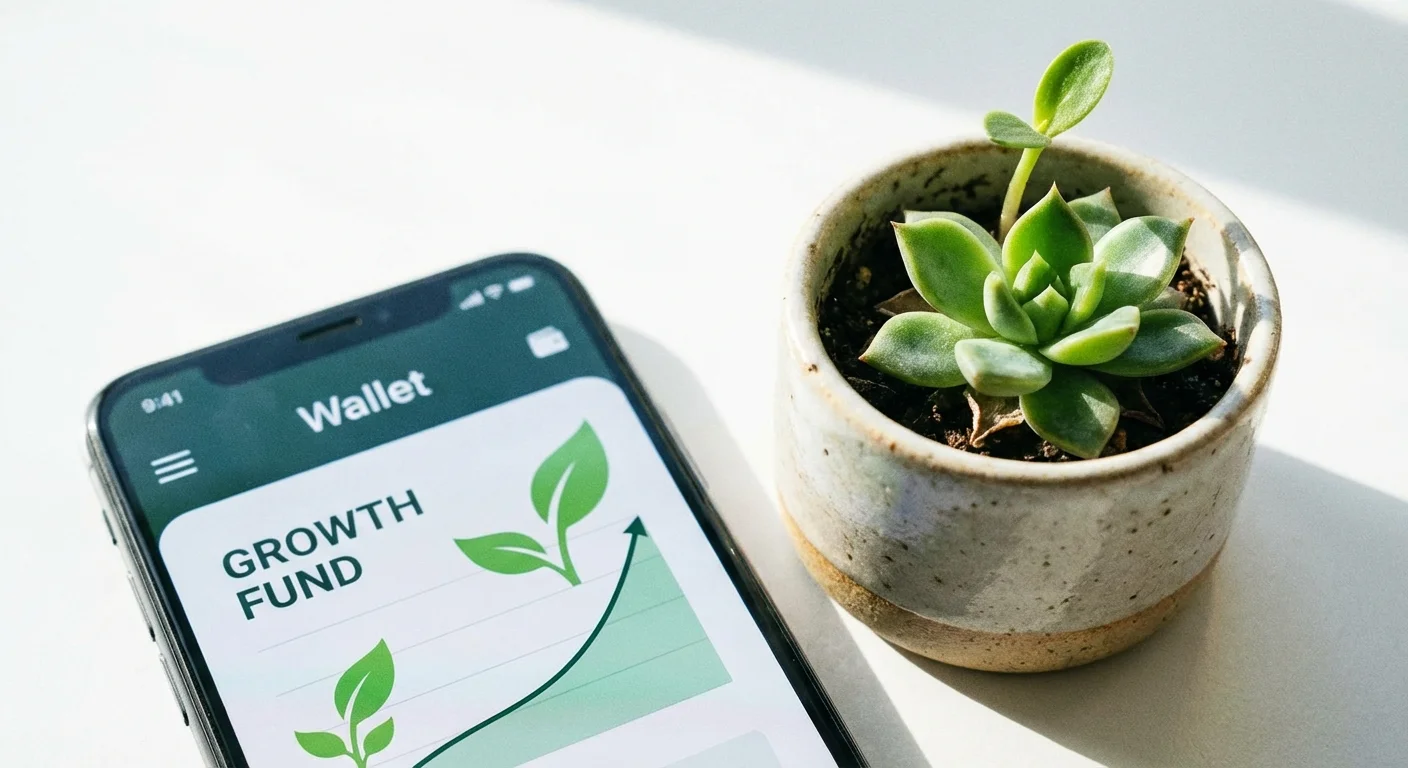
Most micro-saving apps function through a process called “round-up savings.” You link your primary debit or credit card to the app via a secure connection. Every time you make a purchase, the app tracks the “spare change” created by rounding up to the nearest dollar. Once those spare pennies reach a certain threshold—usually $5 or $25—the app pulls that total from your checking account and deposits it into a separate savings or investment account.
There are generally two types of accounts these apps offer:
- High-Yield Savings Accounts: Your change is kept as cash. These accounts are usually held at partner banks and are insured by the Federal Deposit Insurance Corporation (FDIC) up to $250,000. These are best for emergency funds or short-term goals.
- Brokerage Accounts: Your change is used to buy fractional shares of Exchange-Traded Funds (ETFs) or individual stocks. These accounts are protected by the Securities Investor Protection Corporation (SIPC) against the failure of the brokerage, but they are not protected against market losses. If the stock market goes down, your account balance goes down.
The FINRA Investor Education Foundation emphasizes that understanding the difference between “saving” (preserving cash) and “investing” (buying assets for growth) is vital. Micro-saving apps often blur these lines, so you must check where your money is actually going. If you need the money in six months for a car repair, investing it in a volatile stock market through a round-up app might be riskier than placing it in a traditional savings account.

Acorns vs Stash: Choosing the Right Tool for Your Goals
When you explore the landscape of micro-saving apps, two names frequently dominate the conversation: Acorns and Stash. While they share the goal of helping you save small amounts, their philosophies differ significantly. Acorns is designed for the “passive” saver who wants the app to handle all the decisions. Stash is designed for the “active” learner who wants to pick their own investments.
Acorns uses a “Robo-advisor” model. You answer a few questions about your risk tolerance and goals, and the app automatically places your round-ups into a pre-built portfolio of diversified ETFs. You don’t pick the stocks; the app does it for you based on modern portfolio theory. This is excellent if you feel overwhelmed by investment choices.
Stash, on the other hand, provides a curated list of individual stocks and ETFs. It encourages you to “invest in what you know,” allowing you to buy fractional shares of companies like Apple, Amazon, or Tesla. While this offers more control, it also requires more responsibility from you to ensure your portfolio remains diversified.
| Feature | Acorns | Stash |
|---|---|---|
| Primary Method | Automatic Round-ups | Recurring Transfers & Round-ups |
| Investment Choice | Pre-set Portfolios (Passive) | Individual Stocks/ETFs (Active) |
| Monthly Fee | Starts at $3/month | Starts at $3/month |
| Target Audience | Total beginners wanting automation | Beginners wanting to learn stock picking |
| Educational Content | General financial literacy articles | Specific stock market guidance |
Before choosing, consider how much time you want to spend managing the app. If you want to “set it and forget it,” Acorns is often the preferred choice. If you are interested in the mechanics of the stock market and want to practice picking companies, Stash provides a more hands-on experience. Regardless of the choice, remember that SEC guidelines suggest diversification is one of the best ways to manage investment risk.

The Cost of Convenience: Evaluating Fees and Small Balances
This is where micro-saving apps require your closest attention. Most of these apps charge a flat monthly subscription fee, typically ranging from $1 to $9 depending on the tier of service. While $3 a month sounds like a small amount—the price of a single coffee—it can be a massive percentage of your total investment if your balance is low.
Imagine you use a round-up app and manage to save $30 in your first month. If the app charges a $3 monthly fee, you have just paid 10% of your total balance in fees. For comparison, a traditional “expensive” mutual fund might charge 1% per year. In this scenario, you are paying 10% per month. If your investments only grow by 7% in a year, but you are paying $36 a year in fees on a $100 balance, you are effectively losing money every month.
Research published by the CFPB in their 2023 Consumer Credit Report suggests that low-income consumers are often most impacted by flat-fee financial products. To make these apps “worth it,” you generally need to reach a balance where the fee represents a small fraction of your total assets. A $3 monthly fee on a $5,000 balance is only 0.72% annually, which is much more reasonable. If you cannot commit to saving enough to make the fee negligible, you might be better off using a free savings account at a local credit union or an online bank that doesn’t charge monthly maintenance fees.
“The single most important factor in getting rich is getting started, not being the smartest person in the room.” — Ramit Sethi, Author of “I Will Teach You To Be Rich”

The Math of Micro-Saving: Can You Really Reach Your Goals?
Let’s look at the actual numbers. Suppose you make 30 transactions a month with an average round-up of $0.45. This results in $13.50 of monthly savings. In one year, you will have saved $162. While $162 is better than zero, it is unlikely to fund a retirement or a down payment on a house.
However, the power of these apps is not just the round-ups—it is the habit. Most users find that once they see their balance growing, they are motivated to add “recurring contributions.” If you add $25 a week on top of your round-ups, your annual savings jump to nearly $1,500. Over 10 years, assuming a 7% average annual return in the stock market, that $1,500 annual investment could grow to over $21,000. This is where real wealth begins to form.
According to the Bureau of Labor Statistics Consumer Expenditure Survey, the average U.S. household spends thousands annually on non-essential items. Redirecting even a small portion of this through automated apps can create a significant long-term impact. The “wealth” built by round-up savings is often psychological; it proves to you that you can be a saver and an investor, which often leads to more significant financial changes down the road.

Tax and Security Implications: Protecting Your Digital Jar
When you use a micro-saving app that invests in the stock market, you are opening a taxable brokerage account. This is different from a 401(k) or an IRA, which have tax advantages. In a standard brokerage account, you may owe taxes on two things:
- Dividends: If the stocks or ETFs you own pay out profits to shareholders, you must report this as income.
- Capital Gains: If you sell your investments for more than you paid for them, you owe taxes on the profit.
According to IRS Publication 17, you are responsible for reporting these gains and losses on your annual tax return. Most micro-saving apps will provide you with a Form 1099-B at the end of the year to make this easier. Be aware that if you constantly “dip into” your savings by selling your shares, you could trigger frequent tax events, which might complicate your filing process.
Regarding security, ensure any app you use employs bank-level encryption (AES 256-bit) and multi-factor authentication (MFA). Since these apps link directly to your bank account, they are high-value targets for hackers. Always verify that the app is a member of the SIPC, which protects your securities up to $500,000 if the brokerage firm itself fails. Note that SIPC does not protect against “bad” investments or market downturns; it only protects against the disappearance of your assets due to the firm’s insolvency.

Strategies to Maximize Your Micro-Savings Growth
If you decide to use a micro-saving app, don’t just let it run on autopilot. Use these strategies to ensure you are getting the most value for your monthly subscription fee:
- Set Up a “Multiplier”: Some apps allow you to double or triple your round-ups. If a transaction generates a $0.50 round-up, a 3x multiplier will move $1.50 instead. This accelerates your savings without significantly changing your daily experience.
- Combine with Recurring Deposits: As mentioned earlier, round-ups are the “gateway drug” to saving. To offset the monthly fee, set up a recurring deposit of at least $5 or $10 per week. This ensures your balance grows fast enough to make the fee a smaller percentage of your total.
- Use “Found Money” Features: Many apps, like Acorns, have partnerships with retailers. If you shop through the app’s link, the retailer will contribute a small percentage of your purchase into your investment account. This is essentially a “cash-back” program that goes directly into your future.
- Treat it as an “Inaccessible” Fund: One of the best ways to build wealth is to leave the money alone. Avoid the temptation to withdraw your round-ups for weekend spending. Treat this account as a “black hole” where money goes in but doesn’t come out until you reach a specific long-term milestone.
By treating the app as a serious investment tool rather than a novelty, you transition from “saving change” to “building a portfolio.” Over time, these small adjustments can lead to thousands of dollars in difference in your final balance.

Common Pitfalls to Avoid: When Small Savings Aren’t Enough
Micro-saving apps are a great tool, but they aren’t a financial panacea. There are several pitfalls you should watch out for to ensure you don’t stall your financial progress:
The “False Sense of Security” Trap: You might feel like you are “winning” at finances because you are saving your spare change. However, if you are saving $15 a month in an app while carrying $5,000 in credit card debt at 25% APR, you are actually losing ground. The interest on your debt will far outpace any gains you make in a micro-saving app.
Overlooking the Budget: Automated saving can sometimes hide a spending problem. If you don’t know where your money is going, “rounding up” won’t save you. As Dave Ramsey often says, “A budget is telling your money where to go instead of wondering where it went.” Use the app to supplement a budget, not replace it.
Cash Flow Issues: Because round-up apps pull money from your checking account in chunks (often $5 at a time), they can occasionally trigger overdraft fees if your balance is very low. Most apps have “overdraft protection” settings that stop transfers if your balance hits a certain floor, but you must ensure these settings are active.
High Fee Ratios: We cannot stress this enough—if you only have $100 in the account and you’re paying $3 a month, you’re paying a 36% annual fee. This is astronomically high. If you can’t get your balance over $500–$1,000 quickly, a free traditional savings account is almost always a better choice.

When to Consult a Financial Professional
While micro-saving apps are excellent DIY tools for getting started, they have limitations. There are specific milestones in your financial journey where professional guidance is superior to an algorithm:
- When you have significant debt: If you are struggling with high-interest debt, a credit counselor from the National Foundation for Credit Counseling (NFCC) can help you create a payoff plan that might be more effective than micro-saving.
- When you reach $10,000 in assets: Once your “change” grows into a meaningful sum, a Certified Financial Planner (CFP) can help you look at your entire financial picture, including insurance, estate planning, and tax efficiency.
- When you have complex tax questions: If you are frequently trading stocks or have multiple sources of income, a CPA can help you navigate the tax implications to avoid a surprise bill from the IRS.
- During major life changes: Marriage, divorce, the birth of a child, or receiving an inheritance are all times when human expertise is vital to ensure your financial structure still meets your needs.
Remember that apps are designed for the “average” user. A professional can provide a plan tailored to your specific family needs, risk tolerance, and long-term legacy goals. You can find qualified professionals through directories like the CFP Board’s “Find a CFP” tool or the AICPA’s directory for CPAs.
Frequently Asked Questions
Can I lose money in a micro-saving app?
Yes, if the app invests your money in the stock market (like Acorns or Stash), your balance will fluctuate based on market conditions. While the stock market has historically gone up over long periods, there are no guarantees. If you want zero risk of losing your principal, look for an app that puts your money in an FDIC-insured savings account rather than a brokerage account.
Is my money accessible if I need it for an emergency?
Generally, yes, but it isn’t instant. If your money is invested in stocks or ETFs, the app must sell those shares, which takes two business days to “settle” (per SEC rules). Then, transferring the cash to your bank can take another 1-3 business days. Plan for a 3-5 day wait to get your money out.
How do micro-saving apps make money?
Most of these apps make money through monthly subscription fees. Some also earn “interchange” fees if they offer a debit card, or they may earn interest on the cash balances held in your account. Some also receive “referral” fees if you use their “Found Money” or cash-back shopping features.
Are round-up savings enough to retire on?
No. Round-up savings alone will almost never be enough for retirement. According to the Social Security Administration, most people need significantly more than just Social Security and small savings to maintain their lifestyle in retirement. These apps should be viewed as a “starter” tool to build an emergency fund or a small supplemental investment, not your primary retirement strategy.
What are the risks or limitations of these apps?
The primary risks are high fees relative to small account balances, the potential for market loss in brokerage accounts, and the risk of bank account overdrafts if the app pulls money when your balance is low. Additionally, these apps often lack the sophisticated tax-loss harvesting or personalized planning found in full-service brokerage accounts.
When should I consult a professional about this?
You should consult a professional if your micro-savings account becomes a significant portion of your net worth, if you are unsure how the taxes will affect your year-end filing, or if you are using these apps while you have significant unpaid debt. A professional can help you prioritize where your next dollar should go—whether that’s debt payoff, an IRA, or a high-yield savings account.
Do I need a high credit score to use these apps?
No. Most micro-saving apps do not perform a “hard” credit pull because they are not lending you money; they are helping you save or invest your own money. They will verify your identity (as required by federal law) using your Social Security number, but this does not typically impact your credit score.
What happens to my money if the app goes out of business?
If the app is a member of the SIPC (for investments) or uses a partner bank that is a member of the FDIC (for savings), your money is protected up to certain limits. Your assets would typically be moved to another brokerage or returned to you. However, the process could take some time, so it’s always wise to keep your primary emergency fund in a well-established bank.
Last updated: January 2026. Information accurate as of publication date. Financial regulations, rates, and programs change frequently—verify current details with official sources.
This article was reviewed for accuracy by our editorial team.
For trusted financial guidance, visit
Federal Deposit Insurance Corporation (FDIC),
Securities and Exchange Commission (SEC),
Federal Reserve,
Bureau of Labor Statistics (BLS) and
USA.gov Benefits.
Educational Content Notice: This article provides general financial education and information only. It is not personalized financial, tax, investment, or legal advice. Your financial situation is unique—what works for others may not work for you. Before making significant financial decisions, consider consulting with a qualified professional such as a Certified Financial Planner (CFP), CPA, or licensed financial advisor.
Important: EasyMoneyPlace.com provides educational content only. We are not licensed financial advisors, tax professionals, or registered investment advisers. This content does not constitute personalized financial, tax, or legal advice. Laws, tax codes, interest rates, and financial regulations change frequently—always verify current information with official government sources like the IRS, CFPB, or SEC.
No Guaranteed Results: Financial outcomes depend on individual circumstances, market conditions, and factors beyond anyone’s control. Past performance, general strategies, and examples discussed in this article do not guarantee future results. Any financial projections or examples are for illustrative purposes only.
Get Professional Help: For personalized financial advice, consult a Certified Financial Planner (CFP). For tax questions, consult a CPA or enrolled agent. For those experiencing financial hardship, free counseling is available through the National Foundation for Credit Counseling.









Leave a Reply